
The short answer
The best fakes today, sold as “super clones” or “1:1” watches, are good enough to fool most people from photos and many people in hand. They use the right case size, sapphire crystals, ceramic bezels, lume that glows the right colour, and automatic movements built to look like the brand’s own. A few years ago a fake Rolex was easy to spot. In 2026, many are not.
That doesn’t mean you can’t protect yourself. Super clones still fail in predictable places: the movement, the finishing under magnification, accuracy, thickness on thin watches, and above all the price and the seller. A super clone costs its maker a few hundred dollars. The danger isn’t that you’ll buy one for $800 by accident. It’s that someone sells you one as genuine for $10,000.
Three tiers of fakes
- Cheap fakes ($30–$200). Quartz or basic movements, wrong sizes, printed details, non-working functions. Usually obvious, even in photos.
- Mid-tier replicas ($200–$450). Generic automatic movements, closer dimensions and dials, but the wrong movement layout, weak lume and soft details. Most can be caught with a careful look.
- Super clones ($400–$1,500+). Movements built to copy the brand’s own calibre, 1:1 dimensions, matching weight, ceramic and sapphire. These are the ones that get resold as genuine.
The replica factories you’ll hear about
Super clones come from a small number of workshops, mostly in southern China, known by short names. You’ll see these names on replica forums and seller sites, and sometimes in listing titles. If a listing mentions any of them, the watch is a replica. We list them only so you can recognise them: Caliber does not link to, recommend or help anyone buy from replica sellers.
| Name | Most associated with | What buyers should know |
|---|---|---|
| VSF (VS Factory) | Rolex Submariner and Datejust, Omega Seamaster | Known for clone movements such as the “VS3235”, made to look like Rolex’s calibre 3235. |
| Clean Factory | Rolex Submariner, GMT-Master II, Daytona, Datejust | Known for case and bracelet finishing; makes chronograph and GMT clones. |
| ARF | Older Rolex sports models | A long-running name for Submariner and GMT copies of the previous generation. |
| BT / BTF, GMF | Rolex Daytona (BT), GMT-Master II (GMF) | Model-specialist names that come and go. |
| ZF | Audemars Piguet Royal Oak 15400, plus Panerai, IWC and others | Associated with a clone of AP’s older calibre 3120. |
| APS | Audemars Piguet Royal Oak 15500 and 15510 | Associated with a clone of AP’s calibre 4302. |
| 3KF, PPF | Patek Philippe Nautilus and Aquanaut | Copy the Nautilus dial and bracelet; the movements are visibly different under the display back. |
| Dandong (“DD”) | Movements for many factories | A movement maker. Names like “DD3235” or “DD3285” refer to its Rolex-style clone calibres. |
| Noob | Rolex, historically | The best-known name of the 2010s; the label is now widely reused by resellers. |
Two cautions. First, factory names are routinely copied by resellers, so the name says little about any single watch. Second, quality changes from batch to batch, so “factory X is undetectable” claims are marketing, not fact.
What the best fakes get right
- Size and weight. Case diameter, lug width and bracelet weight are often within a gram or two of the real watch. Weighing a watch is no longer a reliable test.
- Materials. Sapphire crystals, ceramic bezels with engraved numerals, solid-link bracelets and glowing lume.
- Functions. Working chronographs, independently set GMT hands, quick-set dates and the right movement layout.
- Engravings and serials. Engraved inner rings (rehauts), caseback engravings and serial numbers, often copied from a real watch.
- Papers and boxes. Copies of warranty cards, tags and boxes are sold alongside, and the fakes are good enough to pass a casual look.
Where fakes still fail
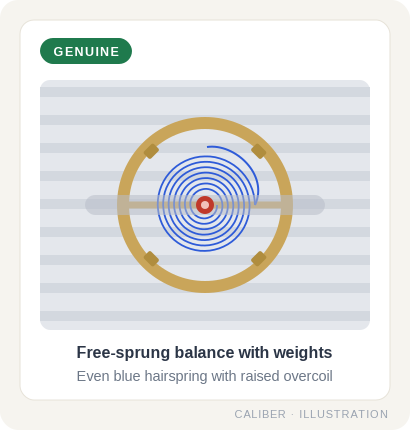
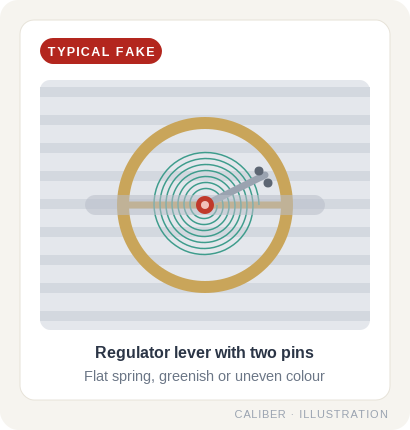
- The movement. This is the decisive test. Clone movements copy the look, but the parts and finishing are different: coarser plating and brushing on the bridges, flat or wrongly coloured hairsprings, a regulator lever where the real watch has a free-sprung balance, cheaper screws and plated rotors where the real one is solid gold. A watchmaker can see this in seconds with the caseback open.
- Accuracy. Genuine modern Rolex, Omega, AP and Patek movements are regulated to a few seconds a day. Clones are typically much less accurate on a timing machine (a timegrapher).
- Thickness. Clone movements are often taller than the originals. On famously thin watches such as the Patek Nautilus 5711 or the Royal Oak “Jumbo”, the fake usually looks chunky from the side.
- Finishing under magnification. Bezel edges, applied markers, printing, polished bevels on bracelet links. Good from arm’s length, softer under a loupe.
- Fit. Small gaps between bezel and case, crowns that feel gritty, and water resistance that isn’t really there.
- Long-term reliability. Clone movements wear faster and few watchmakers will service them.
The real danger: fakes sold as genuine
Most people who end up with a fake didn’t set out to buy one. The common scams:
- Priced just under market. A super clone listed as genuine at 10–30% under the going price looks like a deal, not a fake. Sophisticated sellers avoid prices so low that they scare buyers.
- Fake “full set”. A clone with a copied warranty card, box and tags to justify a higher price.
- Genuine papers, fake watch. Real papers from another watch, paired with a clone. Always match the serial on the card to the serial on the watch.
- Frankenwatches. A mix of genuine and fake parts: a genuine case with a clone movement, or a genuine movement in a fake case. These can pass checks that catch normal fakes.
- Repeated serials. Factories copy serial numbers from real watches, so the same serial can appear on many fakes. Search the serial in quotes: if it shows up on several unrelated listings, walk away.
How to protect yourself: five checks
- Price. Know what the exact reference really sells for. Caliber’s Price check flags prices below 65% of the usual value as “verify carefully” and below 50% as a likely fake or scam.
- Seller. A long, positive history selling watches at this price level. Be wary of new or reactivated accounts.
- Paperwork. Reference and serial must match across the card, the watch and the listing.
- Photos. Ask for clear, timestamped photos, including the side profile, the caseback and the clasp. Use our model guides below for what to look at.
- A watchmaker. For any expensive watch, make the sale conditional on an inspection with the caseback open, or buy through a service that authenticates (such as eBay’s Authenticity Guarantee on eligible US watch sales, or a dealer with a written authenticity guarantee).
Is it illegal to buy a fake watch?
Selling counterfeits is illegal almost everywhere, and selling a fake as genuine is fraud. Buying rules vary by country: in the US, customs can seize counterfeit watches at the border, and some European countries, including France and Italy, can fine buyers too. Fakes also have no resale value, no warranty and no service support. This is general information, not legal advice.
Price check any watchHow to avoid watch scams
Common questions
What is a super clone watch?
A high-end replica that copies the original’s dimensions, materials and functions, usually with a clone of the brand’s own movement. Super clones typically sell for about $400 to $1,500 and are the fakes most often resold as genuine.
Can a super clone pass as real?
From photos and a quick look, often yes. A watchmaker opening the caseback, or timing the watch on a timegrapher, can usually tell. That is why price, seller history and an inspection matter more than any single visual check.
What is VSF?
VSF (VS Factory) is a replica watch factory associated with Rolex Submariner, Datejust and Omega Seamaster copies and clone movements such as the “VS3235”. If a listing mentions VSF, the watch is a replica.
Does weight prove a watch is real?
No. The best fakes now match the real watch’s weight closely. Weight only catches cheaper fakes.
How can I tell if a watch is fake without opening it?
Check the price against what that exact reference really sells for, the seller’s history, that the serial matches the papers, and model-specific details such as the date magnifier, engravings and case thickness. For expensive watches, an opened-case inspection is still the only reliable proof.