
The Hamilton H-10 is made by ETA, the movement factory owned by the Swatch Group, Hamilton’s parent company. It’s Hamilton’s version of the 80-hour automatic family that Tissot sells as the Powermatic 80, Mido as the Caliber 80 and Certina as the Powermatic 80. All four grew out of the classic ETA 2824-2.
An American name with a Swiss engine
Hamilton started in Lancaster, Pennsylvania, in 1892, and made its name with railroad watches. Today it’s a Swiss company based in Biel, and part of the Swatch Group, the world’s biggest watch group.
That ownership is the key to the whole answer. The Swatch Group owns its own movement factory, ETA, and its own hairspring maker, Nivarox. So when Hamilton needs an engine, it doesn’t shop around. It gets one from its sister company.
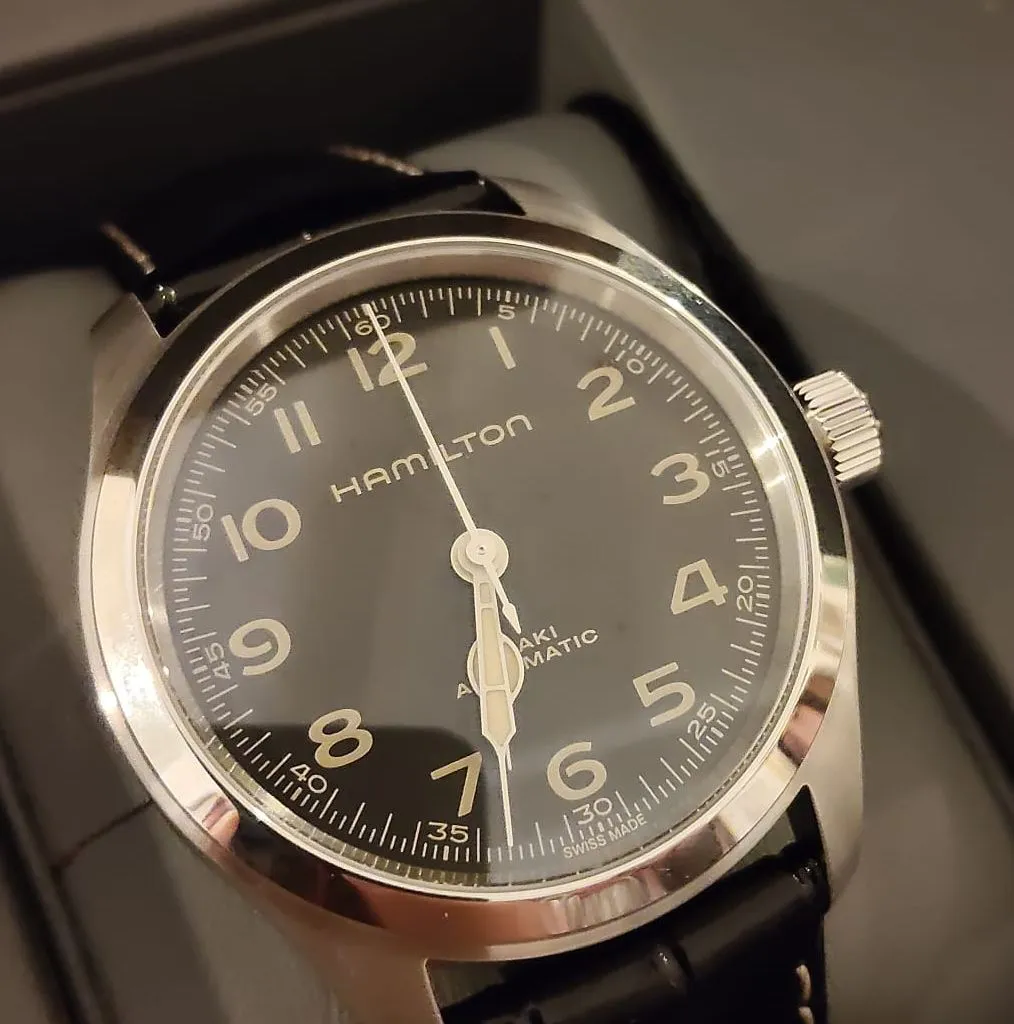
What the H-10 actually is
Hamilton describes the H-10 as a three-hand automatic with an 80-hour power reserve and a Nivachron™ balance spring, made with or without a date. Watch-movement databases list it as Hamilton’s version of ETA’s C07.611, a member of the same family as the Powermatic 80.
| Spec | H-10 | What it means for you |
|---|---|---|
| Made by | ETA (Swatch Group) | Swiss made, big parts supply |
| Power reserve | 80 hours | Take it off Friday night, it’s still running Monday morning |
| Beat rate | 21,600 vibrations/hour (3 Hz) | 6 ticks a second: slightly less smooth sweep than a 4 Hz watch |
| Hairspring | Nivachron™ | An alloy designed to shrug off magnetism from phones and laptops |
How ETA squeezed out 80 hours
The old ETA 2824-2 runs about 38 hours. To more than double that, ETA did two things when it launched the Powermatic 80 (first shown in 2012):
- Slowed the beat from 28,800 to 21,600 vibrations an hour. A slower heartbeat uses less energy.
- Fitted a bigger mainspring barrel, so there’s more energy stored to begin with.
The trade-off is small and mostly invisible: the seconds hand sweeps a touch less smoothly. For most people, never coming back to a dead watch after a weekend is worth far more.
Same factory, same family, four different names on the movement: Hamilton H-10, Tissot Powermatic 80, Mido Caliber 80, Certina Powermatic 80.
The same engine, four badges, very different prices
Here’s where it gets useful for buyers. Because these watches share a movement family, you can choose on looks, case and price without worrying much about what’s inside:
| Watch | Movement name | New (US retail) | Pre-owned (Caliber estimate) |
|---|---|---|---|
| Hamilton Khaki Field Auto 38 | H-10 | $795 | $460 |
| Hamilton Khaki Field Murph | H-10 | $995 | $682 |
| Tissot PRX Powermatic 80, 40 mm | Powermatic 80 | $850 | $443 |
| Tissot Le Locle Powermatic 80 | Powermatic 80 | $795 | $528 |
Pre-owned = Caliber’s estimate for excellent condition with box and papers, updated with every site build.

The Murph costs more because of its story: it’s the watch from the 2014 film Interstellar. The PRX sells on its 1970s integrated-bracelet look. Either way, you’re choosing a design. The heartbeat inside is a close relative.
Not every Hamilton has an H-10
Hamilton uses several movements, so check the listing:
- H-10: three-hand automatics like the Khaki Field Auto and Murph.
- H-50: the hand-wound Khaki Field Mechanical, based this time on the ETA 2801-2.
- Quartz: many Ventura and Jazzmaster models.
On a pre-owned listing, ask for a photo of the caseback and the movement name (often printed on the dial or rotor). If a seller calls a watch “H-10” but the caseback says quartz, walk away.
So who really makes your watch?
Here’s the payoff. When you buy a Hamilton, Tissot, Mido or Certina automatic in this range, you’re buying a Swatch Group engine from ETA in a case and dial designed by the brand you chose. That’s a strength, not a catch: it means proven parts, an 80-hour reserve and service options almost anywhere.
The brand name changes what the watch looks like and what it costs. So compare the price, not just the badge. Look up any of these references in our price checker before you buy.
Price-check the Khaki Field MurphAll Hamilton pricesTissot prices
Common questions
Who makes the Hamilton H-10 movement?
ETA, the Swiss movement maker owned by the Swatch Group, which also owns Hamilton. The H-10 is Hamilton’s version of ETA’s 80-hour automatic family (listed as the ETA C07.611).
Is the Hamilton H-10 the same as the Powermatic 80?
They belong to the same ETA family and share the 80-hour design. Tissot calls its version Powermatic 80, Mido calls it Caliber 80, Certina keeps the Powermatic 80 name, and Hamilton calls its version the H-10. Each brand makes its own adjustments.
How long is the Hamilton H-10 power reserve?
80 hours. Fully wound, it keeps running for more than three days off the wrist.
Is Hamilton a Swiss watch?
Yes. Hamilton was founded in Lancaster, Pennsylvania, in 1892, but today it is a Swiss company based in Biel and part of the Swatch Group, and its automatics are Swiss made.
Is the Hamilton H-10 a good movement?
Yes. It is a proven Swiss automatic with a long 80-hour power reserve and an anti-magnetic Nivachron balance spring. Its 21,600 vph beat gives a slightly less smooth sweep than a 28,800 vph movement.